Typed primitives
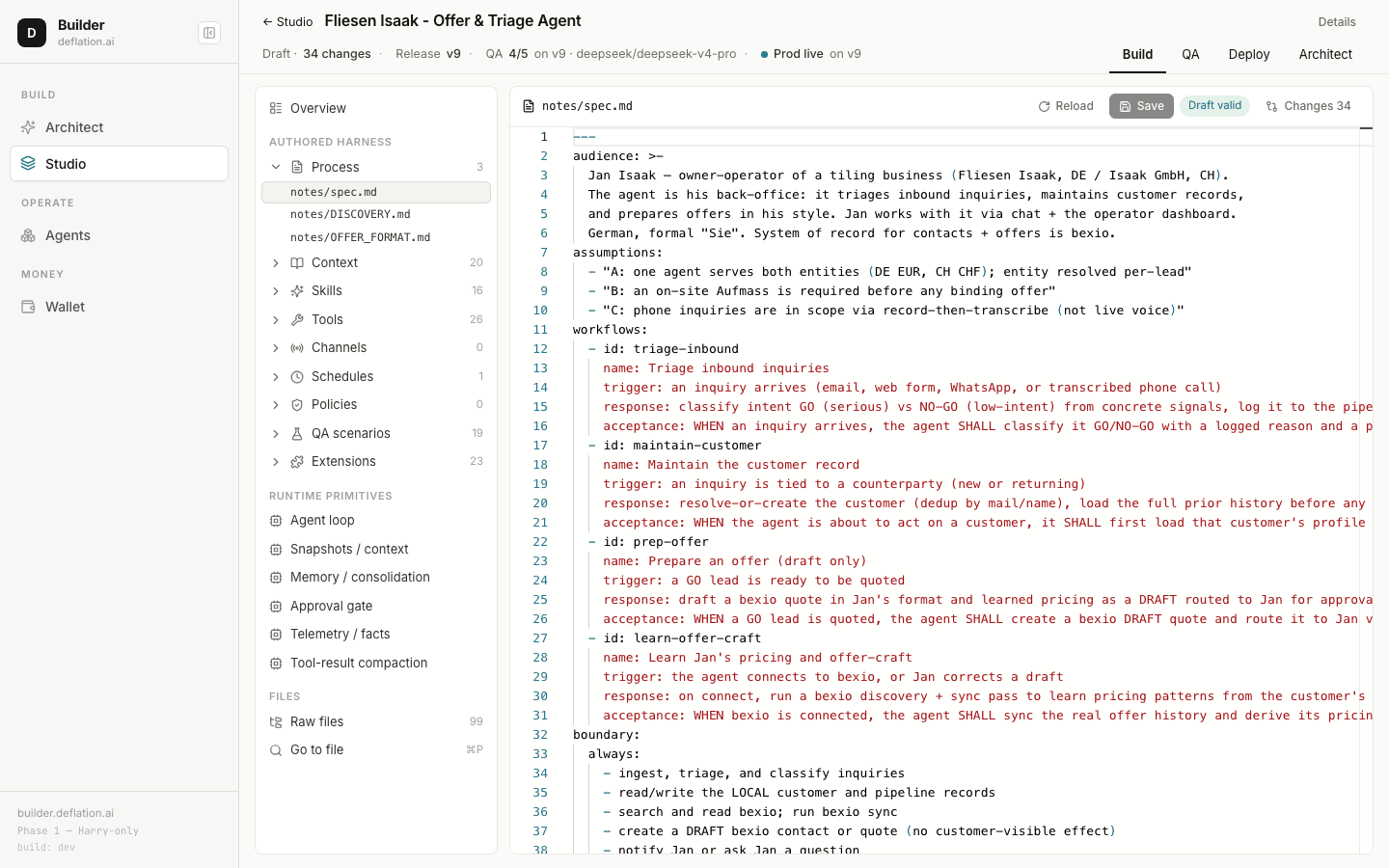
Every component above has a schema — channels, tools, and policies are types, not free-form config.
Map the real process, author its agent harness, prove its decisions and actions, deploy the exact tested release, and operate it with approvals and evidence.
FDEs and AI teams drive the system today. The Architect progressively performs the same governed delivery work.
scopethe outcome→ authorthe harness→ provethe behavior→ operatethe worker
Models can reason. Reliable delivery is still manual. Stop rebuilding the machinery around every agent: author, prove, deploy, govern, and improve workers on shared infrastructure that compounds.
Author every component — in the IDE, or from your own coding agent.
→ 01 author · 03 buildNative primitives: channels, typed tools, plugins, policies — first-class, not glue code.
→ 02 executeBehaviour and reliability testing against a real deployed test instance.
→ 04 proveImmutable releases — every agent ships to its own live instance.
→ 05 runChat with the agent, approve held actions, follow every activity.
→ 06 operateTraces, receipts, and cost — per agent, per run.
→ 06 operateNot a prompt — eight components, versioned together as one unit. Change them like code, review them like code.
typed tools CRM update ERP lookup calendar hold invoice draft
skills invoice triage tone & escalation rules
channels webchat email SMS Telegram
Every component above has a schema — channels, tools, and policies are types, not free-form config.
resolve checks every component against its schema — lint, dependencies, validation — before anything ships.
The runtime understands these primitives natively — channels, typed tools, plugins, prompt mounts, and policies are first-class runtime concepts, not glue code.
Authored and validated — next: what happens when the runtime executes them.
The harness defines it. The loop executes it. One run — context in, tools called, effects gated, every step recorded.
Everything this loop executes gets authored somewhere — next: the Builder MCP, where your coding agent writes it.
Connect Claude Code, Cursor, or any MCP client. It gets the methodology, the gates, and the tools to author every component above — and it cannot skip steps.
Your agent learns the delivery method from the MCP itself — how to map a process, author components, write test scenarios, and when an action needs a human. No docs tab required.
The MCP refuses to skip steps. Evidence, not confidence, moves work forward — and because every component is schema-validated, an invalid shape never reaches a release.
resolve ✓ before releaseqa evidence before deployapproval before consequential actions
It authors every component from the anatomy above — files, tools, channels, tests, policies — in one versioned workspace, like editing a repo.
Connect once — the MCP walks any coding agent through the entire delivery workflow. Then what it built has to survive QA, next.
You define how the agent must behave — and must never behave — and prove it against a real deployed instance before any customer sees it.
Dry runs while authoring; full reruns on demand.
Scenarios rerun on every change — releases ship only on green evidence.
Every run reports what it cost before it ships.
Green evidence in hand, the release ships — next: its own live instance.
Bring one agent. See it survive QA.
Request accessDeploying a release provisions a live server instance with the exact tested components, a worker identity, declared integrations, and connected channels. Consequential outbound actions are held for approval and produce receipts.
The release declares its tools and side effects. Communications and consequential actions flow through the platform, where approvals hold them and receipts record what happened. Stronger network and credential isolation remains an active hardening track.
Deployment is not the finish line — next: operating the agent, day to day.
A deployed agent is not a black box. You chat with it directly, follow everything it does as fact-backed activity, approve or reject its held actions from one inbox — and see what each agent costs.
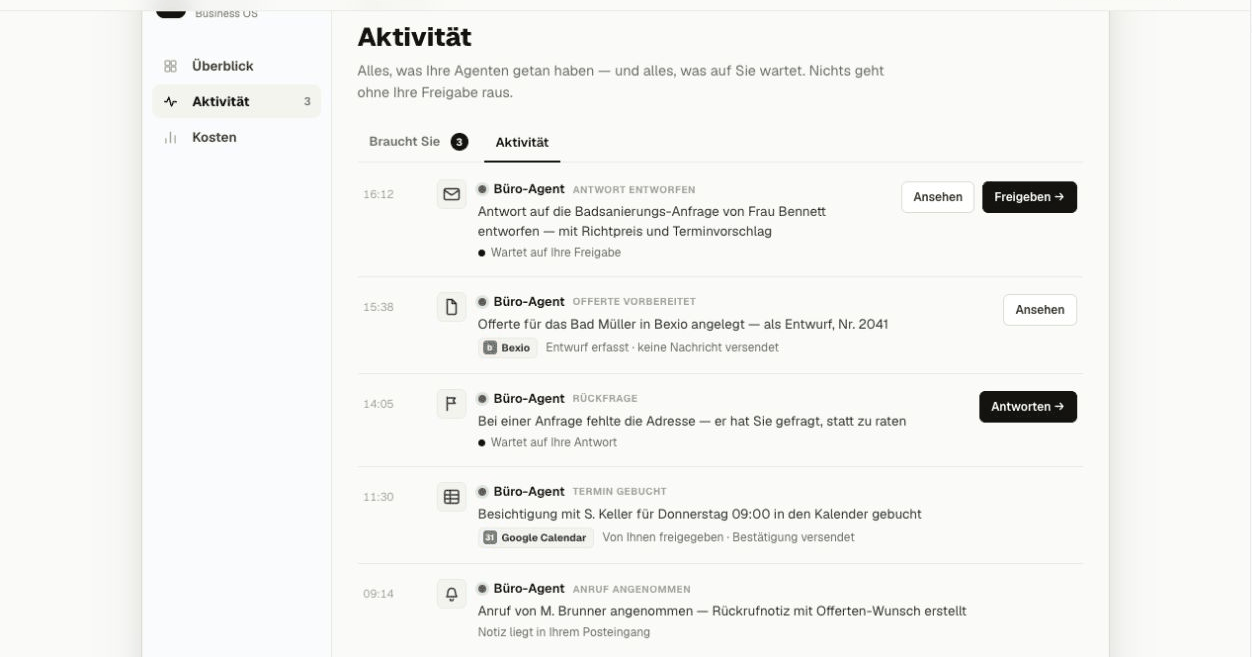
Talk to the deployed agent directly — ask, instruct, correct, on the same channels its work arrives on.
Consequential actions wait for you in one inbox — approve or reject, nothing goes out on its own.
Fact-backed traces of everything the agent did, with an artifact receipt per action.
Usage per agent, per action — you always know what a run cost before the bill does.
And we deliver on these same rails ourselves — the Architect, below.
The Architect is Deflation's forward-deployed agent. Business stakeholders describe the process and the outcome; the Architect scopes the work, authors the components, proves them in QA, and deploys through the same contracts your engineers use.
No separate machinery, no privileged path. If the rails are good enough for our agent to deliver on, they are good enough for yours — early access, below.
For forward-deployed engineers and AI platform teams: one implementation system that turns field work into reusable infrastructure. Early access includes:
No newsletter drip. A short note when the platform is ready for another team.